Does the 4% Rule Still Work for Retirement? (Safe Withdrawal Calculator Guide)
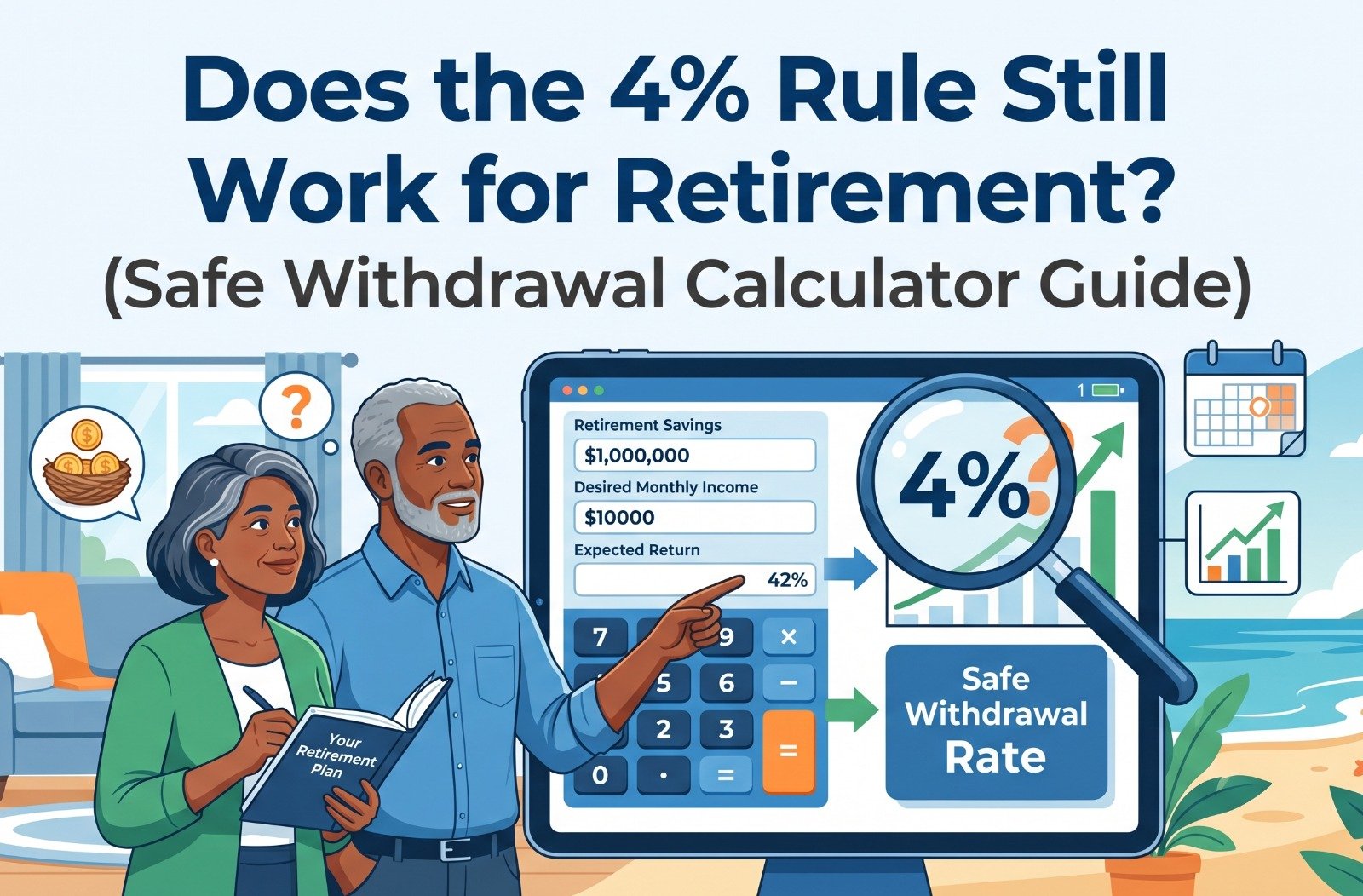
The 4% rule retirement strategy is arguably the most famous guideline in personal finance. For three decades, it has given retirees a simple answer to the terrifying question: "How much can I spend without running out of money?" But in 2026 — with shifting interest rates, elevated stock valuations, and longer life expectancies — the question is no longer whether the rule is useful, but whether it is still safe enough for your retirement.
In this deep-dive guide, we trace the 4% rule from its origins, examine its strengths and weaknesses in today's environment, explore Bill Bengen's updated research, and show you how to move from a one-size-fits-all guideline to a personalized safe withdrawal rate.
Test Different Withdrawal Rates Instantly
Our FIRE Calculator lets you model withdrawal rates from 3% to 5%, see how each affects your portfolio over 30–50 years, and find the right balance between spending and safety. No formulas needed.
Try the FIRE Calculator →What Is the 4% Rule for Retirement?
Origins in the Trinity Study and Bill Bengen's 1990s Research
In 1994, financial advisor William (Bill) Bengen published a groundbreaking paper asking a simple question: what is the maximum withdrawal rate that would have survived every 30-year period in US market history? His answer: approximately 4.15%, which he rounded down to 4% for safety. A few years later, three professors at Trinity University (Cooley, Hubbard, and Walz) independently confirmed the finding using a broader dataset. The "Trinity Study" became the academic backbone of the 4% rule.
The method works like this: in your first year of retirement, you withdraw 4% of your total portfolio. Each subsequent year, you adjust that dollar amount for inflation. A retiree with $1,000,000 would withdraw $40,000 in year one, then $41,200 the next year if inflation is 3%, and so on.
How a 4% Withdrawal Works on Different Portfolio Sizes
| Portfolio Size | Year 1 Withdrawal (4%) | Monthly Income |
|---|---|---|
| $500,000 | $20,000 | $1,667 |
| $750,000 | $30,000 | $2,500 |
| $1,000,000 | $40,000 | $3,333 |
| $1,500,000 | $60,000 | $5,000 |
| $2,000,000 | $80,000 | $6,667 |
Pros and Cons of Using the 4% Rule in 2026
Why Many Advisors Still Use It as a Starting Benchmark
The 4% rule endures because it is simple, intuitive, and historically robust. It survived the Great Depression, World War II, the 1970s stagflation, the dot-com crash, the 2008 financial crisis, and the 2020 pandemic downturn. For someone who just wants a quick sanity check — "Am I roughly on track?" — it remains an excellent starting point.
Limitations in Today's Environment
Critics point to several structural changes since Bengen's original analysis:
- Longer retirements: The original study assumed a 30-year horizon. Early retirees at 45 or 50 face a 40–50 year retirement, which the 4% rate was never designed for.
- Low bond yields: When bonds yield 2–4% instead of the 5–8% that prevailed historically, the "safe" portfolio mix (60/40 stocks-bonds) produces less income.
- Higher valuations: The Shiller CAPE ratio for US stocks remains well above its long-term average, which some researchers correlate with lower forward returns.
Sequence-of-Returns Risk: The 4% Rule's Achilles' Heel
The order in which you experience investment returns matters enormously. Two portfolios can have the same average return over 30 years, but the one that experiences a major decline in the first 3–5 years of retirement can be wiped out, while the one with early gains thrives. This is called sequence-of-returns risk, and it is the primary reason the 4% rule fails in the worst historical scenarios.
From the 4% Rule to Your Personal Safe Withdrawal Rate
Why Some Researchers Now Suggest 3–3.5% for Early Retirees
If your retirement could last 40–50 years, a 4% initial withdrawal rate has a meaningful probability of failure in Monte Carlo simulations. Many FIRE practitioners and financial planners recommend 3% to 3.5% for anyone retiring before 55. This translates to a "28–33x expenses" target instead of the classic 25x — more savings needed, but dramatically higher probability of success over a longer time frame.
Bengen's Updated Research and the 4.7% Headline
In 2025–2026 interviews and articles, Bill Bengen himself revisited his original work. Using expanded data and updated market conditions, he concluded that the worst-case safe withdrawal rate was closer to 4.7% — not the 4% commonly cited. However, this applies to a traditional 30-year retirement starting at 65+, with a specific 75/25 stock-bond allocation. It does not automatically apply to early retirees or those with different asset allocations.
Factoring in Taxes, Fees, and Asset Allocation
The original 4% research assumed pre-tax withdrawals and zero investment fees. In reality, a 0.5% annual fee reduces your effective safe rate, and taxes on 401(k)/IRA withdrawals can consume 15–25% of each dollar withdrawn. A realistic safe withdrawal rate after taxes and fees might be closer to 3–3.5% even for traditional retirees — which brings us back to the conservative end of the spectrum.
Test Your Plan With a Safe Withdrawal & FIRE Calculator
Modeling Different Initial Withdrawal Rates
The best way to understand your risk is to model multiple scenarios. Our FIRE Calculator lets you plug in withdrawal rates of 3%, 3.5%, 4%, or even 4.7% and instantly see how your portfolio evolves over your chosen retirement horizon. You can compare outcomes side by side — how many years your money lasts at each rate, what your ending balance looks like, and whether you're leaving a legacy or cutting it close.
How Retirement Age and Time Horizon Change the Safe Rate
A 30-year-old planning to retire at 45 faces a potentially 50-year retirement. A 58-year-old retiring at 62 faces 25–30 years. The safe withdrawal rate is fundamentally tied to the length of the drawdown period. Run your specific age and savings through a calculator to see where you actually stand — generic rules cannot capture this nuance.
Alternatives and Enhancements to the Classic 4% Rule
Guardrails and Dynamic Spending Rules
Instead of a fixed inflation-adjusted withdrawal, many planners now recommend guardrail strategies: spend more in good years and less in bad years, within predefined upper and lower limits. For example, if your portfolio gains 15%, increase your withdrawal by a set percentage; if it drops 10%, reduce spending temporarily. This adaptive approach dramatically improves portfolio survival rates.
Bucket Strategies, Annuities, and Partial Guarantees
The bucket strategy divides your portfolio into time-based segments: 1–3 years of cash, 3–10 years of bonds, and 10+ years of stocks. You spend from the cash bucket first, giving your stock allocation time to recover from any downturns. Some retirees also purchase annuities to cover essential expenses, guaranteeing a baseline income regardless of market conditions.
Combining Withdrawals With Part-Time Work or Flexible Retirement
Many early retirees don't stop working entirely — they shift to part-time consulting, freelancing, or passion projects that cover a portion of their expenses. Even $15,000–$20,000/year in earned income dramatically reduces portfolio stress and extends the safe withdrawal period.
FAQs About the 4% Rule and Early Retirement
Does the 4% rule still apply if I retire at 45?
Not without adjustment. The original 4% rule was designed for a 30-year retirement. Retiring at 45 could mean a 45–55 year drawdown period, which significantly increases the risk of running out of money. Most FIRE planners recommend 3–3.5% for very early retirees, along with flexible spending strategies.
Can I safely spend more in good markets and less in bad ones?
Yes — this is the core idea behind dynamic or guardrail withdrawal strategies. By adjusting your spending based on portfolio performance (within predefined limits), you can potentially start with a higher initial withdrawal rate while maintaining long-term portfolio safety. Studies show dynamic strategies can support initial rates of 4.5–5% with appropriate guardrails.
How often should I review and adjust my withdrawal plan?
Annually at minimum. Major market events, unexpected expenses, changes in tax law, or life events (health issues, inheritance, relocation) should trigger an immediate review. The 4% rule is a starting point, not a set-it-and-forget-it strategy.
What is the difference between the 4% rule and the 4.7% rate?
Bill Bengen's original 1994 finding was ~4.15% (rounded to 4%). In updated research published in 2025, Bengen argued that with a 75/25 stock-bond allocation, the actual worst-case starting rate was closer to 4.7%. However, this applies specifically to a 30-year retirement with a US-centric portfolio. Early retirees and those with significant international allocation should be more conservative.
Is a 60/40 portfolio still the best for the 4% rule?
Not necessarily. Bengen's updated work found the optimal allocation closer to 75% stocks / 25% bonds. In low-yield environments, bonds contribute less to portfolio growth, and a higher equity allocation — while more volatile — has historically improved long-term survival rates. Your risk tolerance and time horizon should drive this decision.
Put the Theory Into Practice
The 4% rule is a starting point — not a final answer. Use our FIRE Calculator to test different withdrawal rates, see how they perform over your specific timeline, and build a retirement plan based on your real numbers.
Test My Withdrawal Rate →You may also like



Take control of your financial future
Discover our salary calculator, FIRE planner, and more. Free tools with 2026 data to help you make smarter money decisions.
Explore US Tools