How Much Do I Need to Retire? (Simple FIRE Number Calculator Guide)
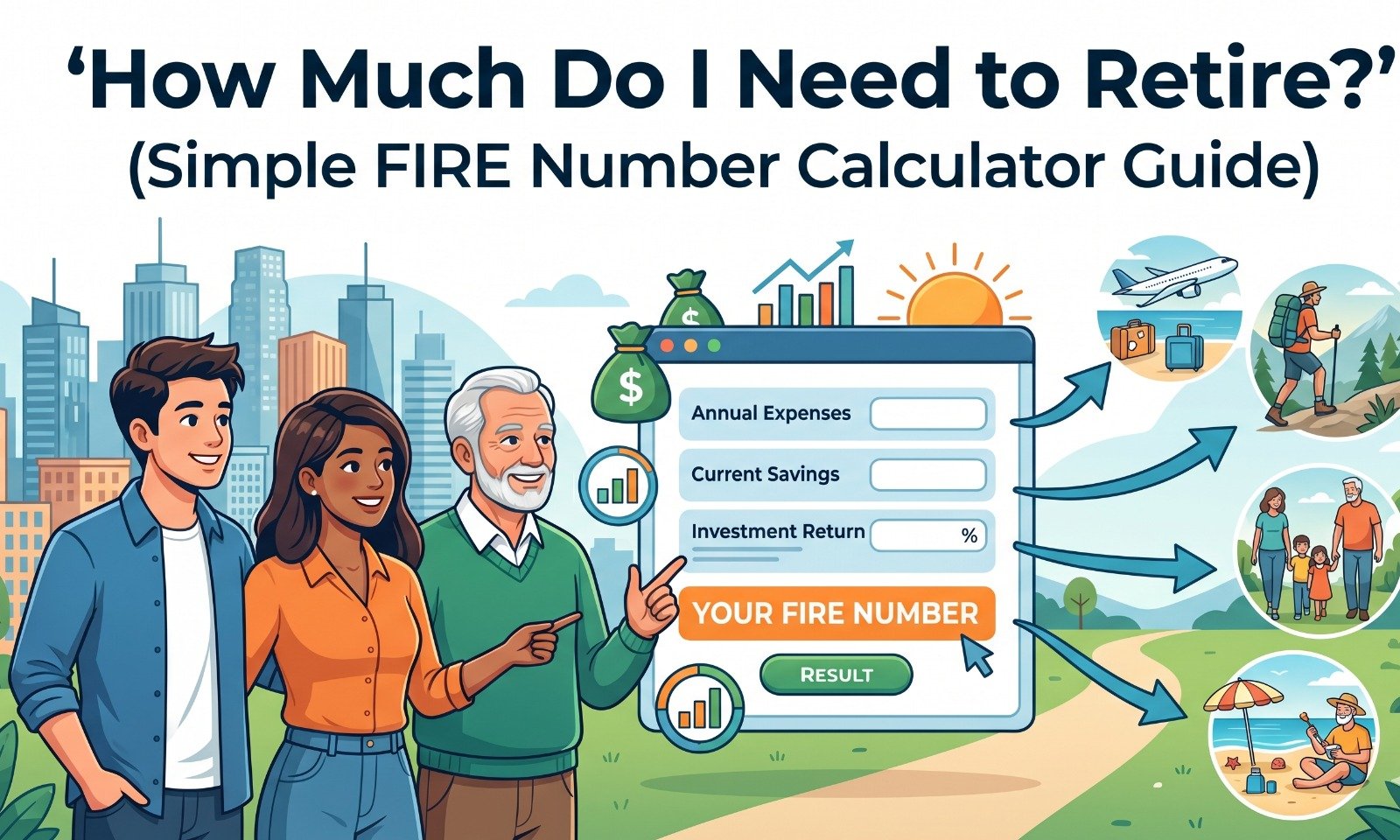
How much do I need to retire is the single most important financial question most Americans will ever ask. According to a 2025 Northwestern Mutual study, Americans now believe they need an average of $1.26 million to retire comfortably — a figure that has climbed steadily over the past five years. But that generic "magic number" may not apply to you at all. Your actual retirement target depends on your lifestyle, your location, the age you plan to stop working, and how you invest.
In this comprehensive guide, we break down the traditional rules of thumb, introduce the FIRE (Financial Independence, Retire Early) approach, and walk you through a step-by-step process to calculate your own personalized retirement number — whether you plan to retire at 67 or at 45.
Get Your Retirement Number in 60 Seconds
Skip the guesswork. Our free FIRE Calculator uses your real income, expenses, savings, and expected returns to tell you exactly when you can retire and how much you need. No signup required.
Calculate My FIRE Number →What Does "How Much Do I Need to Retire?" Really Mean?
The Traditional Rule: Replace 70–80% of Your Pre-Retirement Income
For decades, financial advisors have used a simple guideline: aim to replace 70% to 80% of your pre-retirement income each year. The logic is that retirees typically spend less — no commuting costs, no payroll taxes, and ideally no mortgage. If you earn $80,000 per year, this rule suggests you need $56,000–$64,000 annually in retirement.
But this approach has a fundamental flaw: it is based on income, not on spending. A person who earns $150,000 but only spends $50,000 does not need to replace $105,000–$120,000. This is where the FIRE movement offers a more precise framework.
Why Your "Magic Number" Depends on Lifestyle, Location, and Retirement Age
Retiring in rural Tennessee is fundamentally different from retiring in San Francisco. Healthcare costs in the US average $7,500 per person per year (rising with age), and housing can range from $800/month in low-cost areas to $3,500+ in major metros. A couple planning to travel extensively might need $90,000/year, while a minimalist household could live well on $35,000. Your number is only as good as your expense estimate.
The FIRE Approach: Turning Annual Expenses Into a Retirement Number
How the 4% Rule and the "25x Your Spending" Shortcut Work
The FIRE community popularized a powerful formula: multiply your annual expenses by 25. This comes from the 4% safe withdrawal rate, originally derived from Bill Bengen's 1994 research and later validated by the Trinity Study. The idea is simple — if you withdraw 4% of your portfolio each year (adjusting for inflation), your money has historically lasted at least 30 years.
So if you spend $40,000/year, your FIRE number is $40,000 × 25 = $1,000,000. Spend $60,000/year? You need $1,500,000. Spend $100,000/year? That is $2,500,000.
Estimating Your Annual Expenses in Today's Dollars
The most critical step is building a realistic annual budget for retirement. Break it down into categories:
- Housing: Mortgage/rent, property taxes, insurance, maintenance. If your home is paid off, this drops significantly.
- Healthcare: Premiums, deductibles, out-of-pocket. Before Medicare (age 65), ACA marketplace plans can cost $500–$1,500/month for a couple.
- Food and daily living: Groceries, dining, utilities, transportation.
- Travel and leisure: One of the biggest variables — and the reason most people want to retire in the first place.
- Taxes: Often underestimated. Withdrawals from traditional 401(k)/IRA accounts are taxed as ordinary income.
Example Budgets for Different Lifestyles
| Lifestyle | Annual Expenses | FIRE Number (25x) | Monthly Withdrawal |
|---|---|---|---|
| Lean / Minimalist | $40,000 | $1,000,000 | $3,333 |
| Comfortable / Average | $60,000 | $1,500,000 | $5,000 |
| Premium / Travel-Heavy | $100,000 | $2,500,000 | $8,333 |
How to Calculate Your FIRE Number Step by Step
Step 1 — Estimate Your Annual Retirement Expenses
Use the bottom-up approach: list every category of spending you expect in retirement. Don't forget irregular expenses like car replacements, home repairs, and medical emergencies. A common mistake is using your current spending without adjusting for changes — you may spend less on commuting but more on healthcare and hobbies.
Step 2 — Choose a Safe Withdrawal Rate and Compute Your Target
The classic 4% rate works well for a 30-year retirement. If you plan to retire much earlier (say at 40 or 45), consider a more conservative rate of 3% to 3.5%, which increases your target but adds a safety margin. Bill Bengen himself updated his research in 2025, suggesting some retirees could use up to 4.7% based on updated market data — but this assumes a traditional 65+ retirement.
| Withdrawal Rate | Multiplier | $50k Expenses | $75k Expenses | Best For |
|---|---|---|---|---|
| 3.0% | 33.3x | $1,665,000 | $2,497,500 | Early retirees (40–50 year horizon) |
| 3.5% | 28.6x | $1,430,000 | $2,145,000 | Conservative / long retirement |
| 4.0% | 25.0x | $1,250,000 | $1,875,000 | Traditional (30 year horizon) |
| 4.7% | 21.3x | $1,065,000 | $1,597,500 | Bengen updated (65+ retirees) |
Step 3 — Adjust for Social Security, Pensions, and Part-Time Income
Social Security replaces roughly 40% of pre-retirement income for average earners (the average monthly benefit in 2026 is approximately $1,976). If you expect $24,000/year from Social Security starting at age 67, you can subtract that from your expenses before applying the multiplier. For example: $60,000 expenses minus $24,000 Social Security = $36,000 gap × 25 = $900,000 needed from your portfolio — a much more achievable target.
However, if you retire at 55, you won't receive Social Security for 7–12 years. Your portfolio needs to cover the full amount until benefits kick in.
Use a FIRE Calculator to See If You're On Track
Why Static Rules of Thumb Are Not Enough
Rules like "save 10x your salary by 67" or "save $1.26 million" ignore the enormous variation in individual circumstances. They don't account for your specific tax situation, your investment returns, inflation, or how your spending will change over a 30–40 year retirement. A proper calculator models all of these variables dynamically.
What a Good FIRE Calculator Should Show You
The best retirement calculators go beyond a single number. Look for tools that show your projected Financial Independence date, your FIRE number based on actual expenses, the required monthly savings to hit your target, a year-by-year portfolio projection accounting for inflation, and your progress percentage toward FI. Our free FIRE Calculator does exactly this — plug in your numbers and see your personalized path to financial independence in under a minute.
Common Mistakes When Estimating How Much You Need to Retire
Ignoring Inflation, Healthcare Costs, and Long-Term Care
At 3% annual inflation, $60,000 in today's dollars becomes roughly $108,000 in 20 years. Healthcare costs tend to rise even faster — the average 65-year-old couple can expect to spend $315,000+ on healthcare throughout retirement (Fidelity 2025 estimate). Long-term care, which Medicare does not fully cover, can run $50,000–$100,000+ per year.
Being Too Optimistic About Investment Returns
Assuming 10%+ annual returns based on historical averages ignores fees, taxes, and the fact that sequence of returns matters enormously. A major market crash in your first years of retirement can devastate a portfolio in ways that mid-retirement crashes do not. Most financial planners recommend using 6–7% nominal returns (4–5% real) for long-term projections.
Forgetting Taxes, Fees, and Sequence-of-Returns Risk
Withdrawals from traditional 401(k) and IRA accounts are taxed as ordinary income. A $60,000 withdrawal might only net you $48,000–$52,000 after federal and state taxes. Investment fees — even "low" fees of 0.5% — compound dramatically over decades. Always plan for after-tax, after-fee income.
Frequently Asked Questions About Retirement Numbers
Is $1 million enough to retire in the US in 2026?
It depends entirely on your annual spending. At a 4% withdrawal rate, $1 million generates $40,000/year before taxes. Combined with Social Security, this can work comfortably in lower-cost areas. In expensive cities like New York or San Francisco, it may fall short. The key is matching your portfolio to your actual lifestyle costs.
How does retiring at 55 vs. 67 change the amount I need?
Retiring at 55 means 12 extra years of portfolio withdrawals before Social Security begins, plus the cost of private health insurance until Medicare at 65. This typically increases your target by 30–50% compared to a traditional age-67 retirement. A 3–3.5% withdrawal rate is also advisable for such a long time horizon.
How often should I update my retirement number?
At minimum, once per year — ideally whenever you experience a major life change (job change, relocation, marriage, children). Markets, inflation, and tax laws evolve constantly. Revisiting your plan annually ensures your target stays realistic and your savings strategy stays on track.
Should I include my home equity in my retirement number?
Generally, no — unless you plan to sell or downsize. Your primary residence provides shelter but not income. If you plan to sell and rent (or move to a lower-cost area), you can count a portion of the proceeds, but be conservative with the estimate.
What about inflation — does 25x still work in 2026?
The 25x multiplier already accounts for inflation through the withdrawal method (you increase your annual withdrawal by inflation each year). However, if you expect higher-than-average inflation over long periods, using a 28–30x multiplier (3.3–3.5% withdrawal rate) adds an extra safety buffer.
Ready to Find Your Number?
Stop guessing and start planning. Our FIRE Calculator takes everything in this article — expenses, withdrawal rates, inflation, returns — and turns it into a personalized retirement roadmap. Free, instant, no signup.
Calculate My FIRE Number Now →You may also like

Take control of your financial future
Discover our salary calculator, FIRE planner, and more. Free tools with 2026 data to help you make smarter money decisions.
Explore US Tools