What Is the FIRE Movement? (Financial Independence, Retire Early Explained)
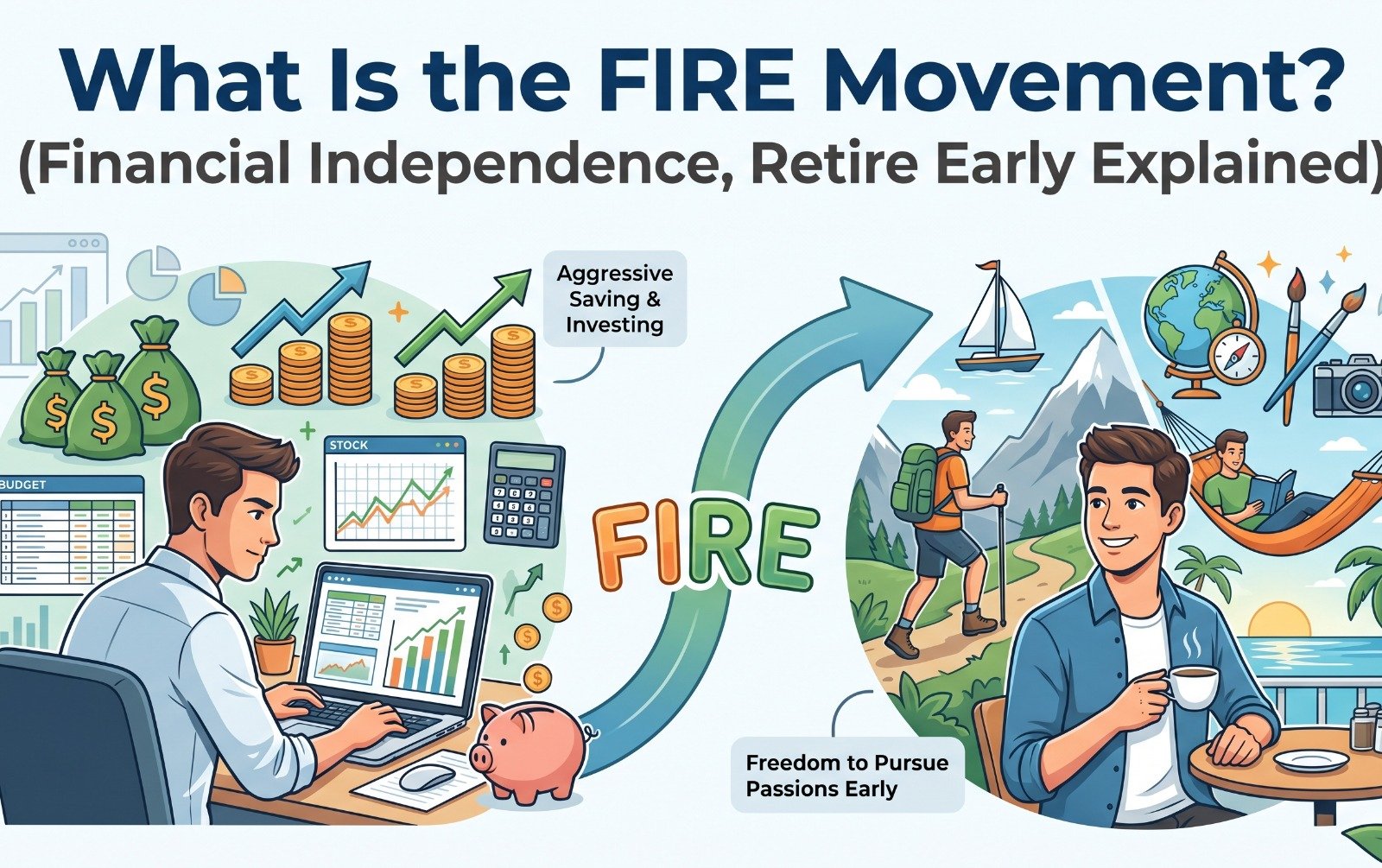
If you have spent any time in personal finance forums, blogs, or social media, you have probably encountered the acronym FIRE. But what is the FIRE movement, really? Is it a radical frugality cult? A Silicon Valley fad? Or a legitimate financial strategy that anyone can use?
The answer is simpler than most people think. FIRE — Financial Independence, Retire Early — is a lifestyle and financial strategy focused on saving and investing aggressively so you can stop depending on a paycheck years or even decades before the traditional retirement age. A 2026 survey reported that the proportion of Americans interested in FIRE rose from 24% to 37% in just one year, signaling that the movement has entered the mainstream.
This guide covers everything you need to know: the core principles, the main types of FIRE, how to calculate your personal FIRE number, and the pros, cons, and risks of pursuing financial independence.
Curious How Long It Would Take You?
Our FIRE Calculator takes your income, expenses, current savings, and expected returns to project your exact Financial Independence date. See your path in under 60 seconds.
Calculate My Path to FIRE →What Does FIRE Stand For? (Financial Independence, Retire Early)
The Core Idea: Saving and Investing Aggressively to Buy Back Your Time
At its heart, FIRE is about one thing: building a portfolio large enough that investment returns cover your living expenses indefinitely. Once you reach this point — your "FIRE number" — work becomes optional. You are financially independent. What you do with that freedom is entirely up to you: travel, volunteer, start a business, spend time with family, or yes, simply retire.
The math is straightforward. If your annual expenses are $50,000 and you use the 4% safe withdrawal rate, your FIRE number is $50,000 × 25 = $1,250,000. Once your investments hit that mark, you can withdraw $50,000/year (adjusted for inflation) with a high probability that your portfolio lasts 30+ years.
How FIRE Differs From Traditional Retirement Planning
Traditional retirement planning revolves around working until 62–67, relying heavily on Social Security and employer pensions, and saving "enough" (often defined vaguely as 10–15% of income). FIRE flips the script: the focus shifts to maximizing savings rate (often 50–70% of income), minimizing expenses, and investing aggressively in low-cost index funds. The goal is not comfort at 67 — it is freedom at 35, 40, or 50.
The Main Types of FIRE: Lean, Fat, Coast, and Barista
Lean FIRE — Extreme Frugality and Minimalist Lifestyles
Lean FIRE practitioners aim for financial independence on a below-average budget, typically $25,000–$40,000/year per person or couple. This requires extreme frugality: house hacking, minimal car use, cooking all meals, and avoiding lifestyle inflation. The FIRE number is lower ($625,000–$1,000,000), making it achievable on moderate incomes, but the tradeoff is a very lean retirement lifestyle.
Fat FIRE — High-Income, High-Comfort Early Retirement
Fat FIRE is the opposite end of the spectrum: achieving financial independence while maintaining a comfortable or luxurious lifestyle. Annual budgets of $100,000–$200,000+ mean FIRE numbers of $2.5M–$5M or more. This path is typically pursued by high-income professionals (tech, medicine, law, finance) who earn enough to save aggressively without extreme deprivation.
Coast and Barista FIRE — Partial Independence and Semi-Retirement
Coast FIRE means you have invested enough that, if left untouched, your portfolio will grow to a full FIRE number by traditional retirement age (e.g., 65). You still work, but only to cover current expenses — you no longer need to save. Barista FIRE is similar: you have enough invested to cover most of your expenses, and you work a low-stress part-time job (the term originated from working at Starbucks for health benefits) to cover the gap and maintain health insurance.
| FIRE Type | Annual Budget | Approx. FIRE Number | Key Characteristic |
|---|---|---|---|
| Lean FIRE | $25,000–$40,000 | $625K–$1M | Extreme frugality, minimalist |
| Regular FIRE | $40,000–$70,000 | $1M–$1.75M | Moderate lifestyle, balanced |
| Fat FIRE | $100,000–$200,000 | $2.5M–$5M | Comfortable / luxurious retirement |
| Coast FIRE | Varies | Varies (invested early) | No more saving needed, just covering expenses |
| Barista FIRE | Varies | Partial portfolio + part-time work | Semi-retired, part-time for benefits |
Key Principles of the FIRE Movement
High Savings Rate (Often 50–70% of Income)
The savings rate is the single most important variable in reaching FIRE. A person saving 10% of their income might take 40+ years to reach FI. At 50%, it drops to roughly 17 years. At 70%, you could be financially independent in 8–10 years, regardless of income level. This is why the FIRE community obsesses over savings rate — it is the lever that most directly controls your timeline.
Low-Cost Index Investing and Long-Term Compounding
Most FIRE adherents invest in broadly diversified, low-cost index funds (like total US stock market or S&P 500 index funds with expense ratios under 0.10%). The strategy is simple: buy, hold, and let compound interest work over decades. Trying to beat the market through stock picking or timing rarely works — and the fees associated with active management erode returns significantly over time.
Optimizing Housing, Transport, and Taxes to Free Up Cash Flow
The three biggest expense categories for most Americans are housing, transportation, and taxes. FIRE practitioners target these aggressively: house hacking (buying a duplex and renting half), driving used cars, living in lower-cost cities, maximizing tax-advantaged accounts (401k, IRA, HSA), and using strategies like Roth conversion ladders to minimize taxes in early retirement.
How the FIRE Movement Uses the 4% Rule and FIRE Numbers
Defining a FIRE Number Based on Annual Expenses
Your FIRE number = Annual Expenses ÷ Safe Withdrawal Rate. At 4%, this is simply Annual Expenses × 25. At 3.5% (more conservative for early retirees), it is Annual Expenses × 28.6. The key insight: your expenses — not your income — determine your FIRE number. Cutting $10,000/year from your expenses reduces your target by $250,000.
Examples of FIRE Numbers for Different Lifestyles and Cities
| City / Lifestyle | Annual Expenses | FIRE Number (4%) | FIRE Number (3.5%) |
|---|---|---|---|
| Rural Midwest (minimal) | $30,000 | $750,000 | $857,000 |
| Mid-size city (comfortable) | $55,000 | $1,375,000 | $1,571,000 |
| Major metro (NYC, SF) | $90,000 | $2,250,000 | $2,571,000 |
| International geo-arbitrage | $25,000 | $625,000 | $714,000 |
Why Early Retirees Often Use More Conservative Assumptions
A 35-year-old retiring with a 50-year horizon faces more uncertainty than a 65-year-old with a 25-year horizon. More years mean more exposure to black swan events, policy changes, and compounding inflation. Using a 3–3.5% withdrawal rate (28–33x expenses) provides a significant margin of safety for early retirees.
Calculate Your Path to FIRE With a Dedicated FIRE Calculator
Inputs You Need: Income, Expenses, Savings, Returns, Inflation
A good FIRE calculator asks for your current annual income, annual expenses (or savings rate), current invested assets, monthly contributions, expected investment return, and expected inflation rate. With these inputs, it can project your portfolio growth year by year and identify the exact year you cross your FIRE number threshold.
What You Get: FI Date, FIRE Number, and Required Savings Rate
Our FIRE Calculator shows you your projected Financial Independence date, your FIRE number based on your actual expenses, a year-by-year portfolio projection chart, your progress percentage, and the required monthly savings to hit your goal on time. Plug in your real numbers and see exactly where you stand.
How Often to Rerun Your Plan as Life Changes
Life is not static. Salary increases, job changes, new expenses (children, healthcare), windfalls, or market shifts all change your timeline. Revisit your FIRE plan at least annually — or whenever a major financial event occurs. The goal is to keep your plan aligned with reality.
Pros, Cons, and Risks of the FIRE Lifestyle
Benefits: Freedom, Autonomy, and Intentional Spending
The primary benefit of FIRE is optionality. You choose how to spend your time and energy. Many FIRE retirees report higher life satisfaction, lower stress, and a greater sense of purpose — even if they continue working on projects they love. FIRE also forces intentional spending: you become acutely aware of what truly brings you value.
Risks: Burnout, Social Pressure, and Market Volatility
The aggressive saving phase can cause burnout and strain relationships. Some people sacrifice too much present happiness for a future goal. Market downturns in the first years of early retirement can trigger sequence-of-returns risk. And leaving a career early can mean losing professional networks, identity, and employer-sponsored benefits.
Psychological Aspects of Leaving Traditional Work Early
Many FIRE retirees report an unexpected challenge: the loss of structure and social connection that comes with a full-time job. Having a plan for how you will spend your time — hobbies, volunteering, part-time work, travel — is just as important as the financial plan.
Is the FIRE Movement Right for You?
What signs suggest I might be a good fit for FIRE?
You value time and autonomy over material possessions. You are willing to delay gratification. You are comfortable with a degree of financial risk. You have a clear idea of what you would do with your freedom — or are excited to find out.
Can I try FIRE principles without fully quitting my job?
Absolutely. Many people adopt FIRE habits — high savings rate, index investing, expense optimization — without planning to retire at 35. Even reaching Coast FIRE (enough invested that you no longer need to save) dramatically reduces financial stress and gives you career flexibility.
Is FIRE only for high-income earners?
No. While higher income makes the math easier, the savings rate — not the dollar amount — is what determines your timeline. Someone earning $50,000 and saving 50% ($25,000/year) will reach Lean FIRE faster than someone earning $200,000 and saving 10% ($20,000/year). FIRE is fundamentally about the gap between income and expenses.
What about healthcare before age 65 in the US?
This is one of the biggest challenges for American FIRE retirees. Options include ACA marketplace plans (with subsidies if your income is low enough), health sharing ministries, COBRA (temporary), or part-time work specifically for employer benefits (Barista FIRE). Some pursue geo-arbitrage — retiring in countries with affordable universal healthcare.
How has the FIRE movement changed in 2026?
FIRE has become more nuanced and mainstream. The "retire at 30 on rice and beans" narrative has given way to a spectrum — Lean, Regular, Fat, Coast, Barista — that acknowledges different lifestyles and income levels. Financial institutions (Fidelity, Vanguard, Mutual of Omaha) now publish FIRE-focused content. The core principles remain the same, but the community is more diverse and less dogmatic than a decade ago.
Start Your FIRE Journey Today
The best time to start was yesterday. The second best time is now. Our FIRE Calculator will show you exactly where you stand, how long until you reach Financial Independence, and what you need to change to get there faster.
See My FIRE Timeline →You may also like

Take control of your financial future
Discover our salary calculator, FIRE planner, and more. Free tools with 2026 data to help you make smarter money decisions.
Explore US Tools