How Long Will It Take Me to Reach FIRE? (Savings Rate vs. Early Retirement Age)
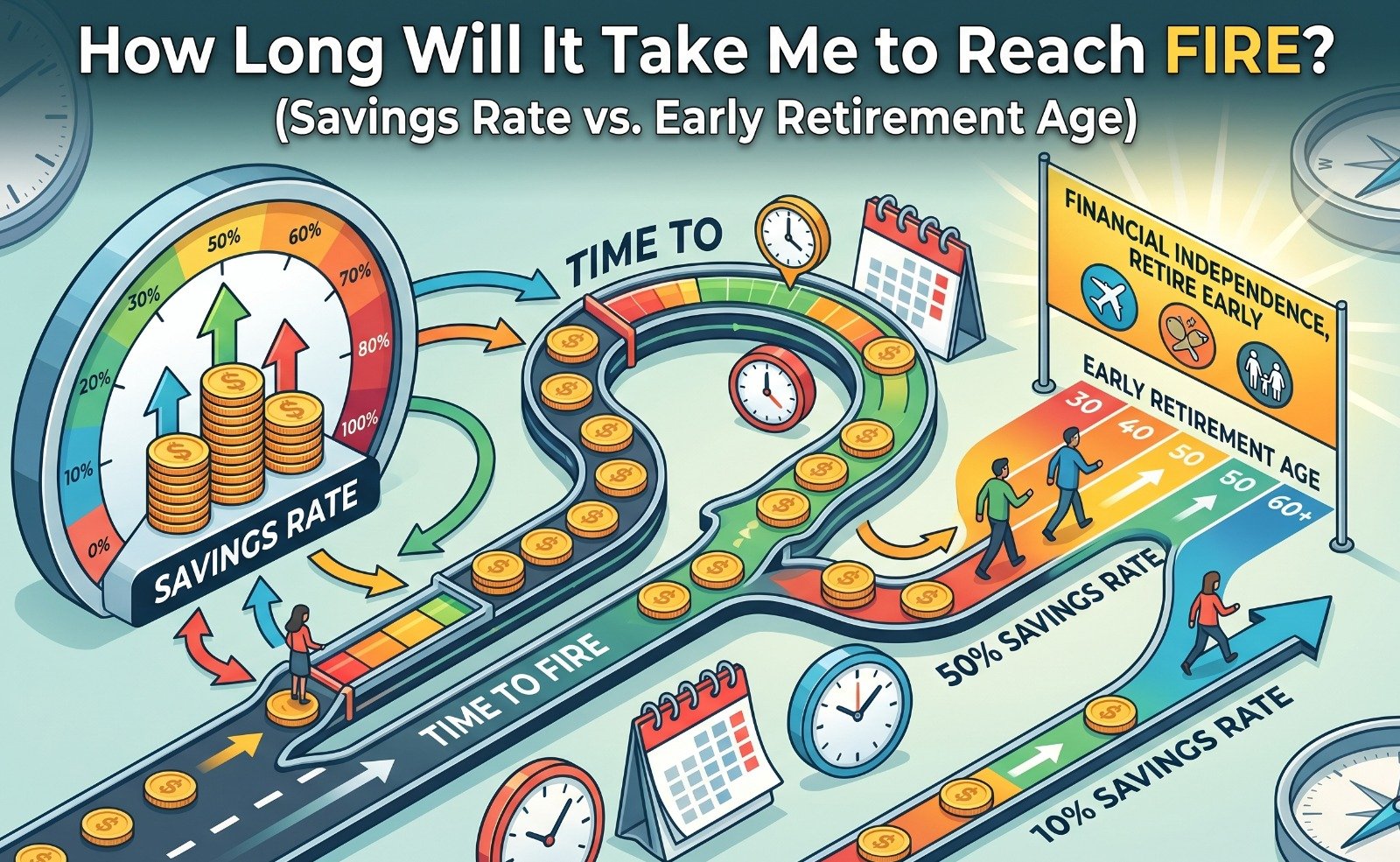
You have heard about FIRE — Financial Independence, Retire Early. You like the idea. But the question burning in your mind is practical: how long will it take me to reach FIRE given my income, my expenses, and my current savings? The answer is not a single number. It depends primarily on one variable that most financial advice ignores: your savings rate.
In this guide, we break down the relationship between savings rate and time to financial independence, explore the factors that speed up or slow down your path, and show you how to use a FIRE calculator to get a personalized timeline based on your real numbers — not generic averages.
See Your Personal FIRE Timeline
How many years until Financial Independence? Our FIRE Calculator turns your income, expenses, savings, and expected returns into a projected FI date. Adjust the inputs and watch the timeline change in real time.
Calculate My Years to FIRE →What Does It Mean to "Reach FIRE"?
The Definition: Investments Cover Your Living Expenses
You have "reached FIRE" when your invested assets generate enough return to cover your annual living expenses indefinitely. At that point, working for money becomes optional. The standard benchmark: when your portfolio reaches 25× your annual expenses (based on the 4% safe withdrawal rate), you are financially independent.
Importantly, this is not about having a specific dollar amount in a savings account. It is about the relationship between your portfolio and your spending. Someone who spends $30,000/year reaches FIRE at $750,000. Someone who spends $100,000/year needs $2,500,000. The number is personal.
FIRE Number vs. Traditional Retirement Savings Targets
Traditional advice says "save 10x your salary by 67." The FIRE approach says "save enough that your investments cover your expenses — regardless of age." The FIRE framework is more precise because it is based on expenses, not income. A person earning $200,000 who spends $60,000 needs the same FIRE number as someone earning $80,000 who also spends $60,000. Income determines speed; expenses determine the destination.
How Savings Rate Determines Your Time to FIRE
The Classic Savings Rate vs. Years-to-FI Table
One of the most powerful concepts in FIRE is this: your savings rate, not your income, determines how many working years you need. This table assumes you start from zero, invest in a diversified portfolio returning 5% real (after inflation), and reach a portfolio of 25x annual expenses:
| Savings Rate | Years to FIRE | Key Insight |
|---|---|---|
| 10% | ~51 years | Traditional pace — retire at 72 if you start at 21 |
| 20% | ~37 years | Retire at 58 starting at 21 |
| 30% | ~28 years | Retire at 49 — the "sweet spot" for many |
| 40% | ~22 years | Retire at 43 starting at 21 |
| 50% | ~17 years | The classic FIRE milestone |
| 60% | ~12.5 years | Aggressive — requires high income or low costs |
| 70% | ~8.5 years | Extreme — but mathematically sound |
| 80% | ~5.5 years | Rare, usually high earners in low-cost areas |
The non-linear nature of this table is striking. Going from 10% to 20% savings cuts 14 years off your timeline. Going from 50% to 60% saves another 4.5 years. Each percentage point of savings rate has a compounding effect on your timeline.
Why Investing Your Savings (Not Just Holding Cash) Is Critical
The table above assumes your savings are invested, not sitting in a bank account earning 0.5%. At 5% real returns, your money roughly doubles every 14 years. In a savings account, it barely keeps pace with inflation. The difference between investing and not investing can be 15–20 years in your timeline. Low-cost index funds (S&P 500, total market) are the standard vehicle for FIRE savers.
Examples: 20%, 40%, 60%, and 70% Savings Rates
Consider a person earning $75,000/year after tax:
- 20% savings rate ($15,000/year): Spends $60,000, needs $1,500,000. At 5% real returns from zero, takes ~37 years.
- 40% savings rate ($30,000/year): Spends $45,000, needs $1,125,000. Takes ~22 years.
- 60% savings rate ($45,000/year): Spends $30,000, needs $750,000. Takes ~12.5 years.
- 70% savings rate ($52,500/year): Spends $22,500, needs $562,500. Takes ~8.5 years.
Notice how increasing the savings rate does double duty: it increases the annual investment amount while simultaneously reducing the FIRE number target (because you need less to cover lower expenses). This dual effect is why savings rate is the most powerful lever in FIRE.
Other Factors That Speed Up or Slow Down Your Path to FIRE
Investment Returns and Sequence of Returns
Higher returns compress your timeline dramatically. At 7% real returns (optimistic but historically achievable for 100% stock portfolios), a 50% saver reaches FIRE in ~14 years instead of 17. However, returns are not guaranteed. A sustained downturn early in your accumulation phase can delay your timeline, while strong early returns accelerate it. This is why consistent investing regardless of market conditions (dollar-cost averaging) is the standard FIRE strategy.
Lifestyle Inflation, Cost-of-Living Changes, and Geo-Arbitrage
Lifestyle inflation — spending more as you earn more — is the silent killer of FIRE timelines. If you get a $15,000 raise and increase your spending by $10,000, you only captured one-third of the potential savings acceleration. FIRE practitioners deliberately resist lifestyle inflation and channel raises into savings.
Geo-arbitrage — relocating to a lower-cost area — is one of the most powerful accelerators. Moving from San Francisco (where a modest life costs $80,000+) to a mid-size city in the Southeast ($40,000) can cut your FIRE number in half and shave a decade or more off your timeline. Some FIRE retirees take this further by relocating to countries like Portugal, Mexico, or Thailand where $25,000–$35,000/year provides a comfortable lifestyle.
Increasing Income vs. Cutting Expenses: Which Moves the Needle More?
Both matter, but they work differently. Cutting $10,000 in annual expenses reduces your FIRE number by $250,000 and frees up $10,000 more per year to invest — a double impact. Earning $10,000 more only increases savings (if you don't inflate your lifestyle). In the early stages, expense cutting tends to have a bigger percentage impact. As income grows, increasing earnings becomes the dominant lever.
See Your Personal Timeline With a FIRE Calculator
The Inputs You Need
A good FIRE calculator asks for: annual income (after tax), annual expenses, current invested assets, expected annual investment return, and expected inflation rate. From these, it computes your savings rate, your FIRE number, and projects year-by-year portfolio growth until you cross the FI threshold.
How the Calculator Turns Savings Rate Into an Expected FI Date
Our FIRE Calculator shows you a projected Financial Independence date, a year-by-year chart of your portfolio growth, your required monthly savings, and how your progress percentage changes over time. It's the personalized answer to "how long will it take me?"
Playing With "What If" Scenarios
The real power of a calculator is scenario testing. What if you increase your savings rate by 5%? What if you earn a higher return? What if you move to a lower-cost city? Each change instantly updates your projected FI date, letting you find the combination of levers that works best for your life.
Strategies to Shorten Your Time to FIRE
Big Wins: Housing, Transportation, Taxes, and Debt Payoff
The largest expense categories offer the largest savings potential:
- Housing: Downsizing, house hacking, or relocating can save $500–$2,000/month.
- Transportation: Switching from a new car to a reliable used car, eliminating a second vehicle, or using public transit can save $300–$800/month.
- Taxes: Maximizing 401(k), IRA, and HSA contributions reduces your tax bill and accelerates investment growth. The tax savings on a $23,000 401(k) contribution can be $5,000–$8,000/year.
- Debt: Paying off high-interest debt (credit cards, personal loans) frees up cash flow and eliminates a drag on your net worth.
Side Hustles and Career Moves That Accelerate FI
Increasing income is the other side of the equation. Negotiating a raise, switching to a higher-paying role, starting a side business, or freelancing can add $10,000–$50,000+ to your annual savings. The key is channeling 100% of the additional income into investments rather than lifestyle inflation.
Avoiding Burnout and Maintaining Quality of Life
FIRE is a marathon, not a sprint. Saving 70% of your income for 10 years is impressive — but not if it causes burnout, damages relationships, or makes you miserable. Sustainable FIRE plans include a budget for things that bring genuine joy: travel, hobbies, dining out, experiences. The goal is to eliminate wasteful spending, not to eliminate all spending.
FAQs About How Long It Takes to Reach FIRE
Is 10 years to FIRE realistic for an average earner?
It depends on your savings rate more than your income. A household earning $75,000 after tax that saves 60% ($45,000/year) and spends $30,000 can reach a $750,000 FIRE number in approximately 12 years (starting from zero). That is close to 10 years if you have any existing savings or can push the rate slightly higher. It requires discipline but is mathematically achievable.
What if I start in my 40s instead of my 20s?
Starting later means you have fewer compounding years, but you likely have a higher income and potentially some existing savings. A 40-year-old starting with $200,000 saved and saving $40,000/year at 5% real returns can reach $1,000,000 (Lean/Regular FIRE) in approximately 12–14 years — retiring at 52–54. It is absolutely possible; the savings rate is what matters most.
How often should I recalculate my path to FIRE?
At least annually, and after any major financial event (raise, job change, relocation, market crash, large expense). Your timeline is a living projection, not a fixed plan. Regular updates keep you motivated and allow you to adjust course early if you are falling behind.
Does the savings rate table account for existing savings?
No — the standard table assumes you start from zero. If you already have significant savings, your time to FIRE is shorter. A calculator is the best way to account for your current portfolio, since even $50,000–$100,000 of existing investments can shave years off the timeline due to compound growth.
What return rate should I assume in my projections?
Most FIRE planners use 5% real returns (after inflation) as a reasonable long-term estimate for a diversified stock-heavy portfolio. This is conservative relative to the historical ~7% real return of the S&P 500 but provides a safety margin. Using nominal returns (7–10%) without subtracting inflation will make your timeline look unrealistically short.
Your FIRE Timeline Starts Now
The savings rate table gives you the theory. Our FIRE Calculator gives you the answer — personalized to your income, expenses, current savings, and goals. Find out exactly how many years stand between you and financial independence.
Find My FIRE Date →You may also like
Take control of your financial future
Discover our salary calculator, FIRE planner, and more. Free tools with 2026 data to help you make smarter money decisions.
Explore US Tools